

- Slow interactions lose buyers. Fix Interaction to Next Paint first.
- Break long tasks before users feel the delay
- Your primary offer must appear fast. Optimize Largest Contentful Paint.
- Prioritize the actual LCP element
- Failing mobile Core Web Vitals is costing more than rankings.
- Moving page elements destroy trust. Eliminate Cumulative Layout Shift.
- Stabilize media, fonts, and dynamic modules
- A green lab score is not enough. CrUX shows what Google sees.
- Framework defaults can slow growth. Set rules for React and Next.js.
- Build performance budgets into the release process
- Every storefront app adds weight. Protect Shopify and WooCommerce revenue pages.
- Prioritize the revenue pages before the blog
- Generic fixes leave money behind. RankJockey connects speed to commercial results.
- Need a clear path to better Core Web Vitals? Start with these answers.
- How long does core web vitals remediation take for an enterprise website?
- What is included in professional Core Web Vitals remediation services?
- Can Core Web Vitals remediation improve ecommerce conversion rates?
- Why does my site pass Lighthouse but fail Core Web Vitals in Search Console?
- Which Core Web Vital should we fix first: INP, LCP, or CLS?
- How does RankJockey approach enterprise Core Web Vitals remediation?
- Build a faster, more defensible organic acquisition engine.
- Your competitors are already buying faster customer experiences.
Core Web Vitals Remediation: The 2026 Enterprise Blueprint for INP, LCP & CLS
Core Web Vitals remediation is not a cosmetic speed task. It is a revenue-focused engineering program. Slow pages lose organic traffic, weaken conversion paths, and reduce paid media efficiency. Mobile users often leave before your team captures demand. That happens when Largest Contentful Paint is slow, Interaction to Next Paint is delayed, or layouts shift. RankJockey helps CTOs, CMOs, growth teams, marketing leaders, and ecommerce directors find the code, hosting limits, rendering issues, and vendor scripts that hurt real users. We focus on measurable CrUX gains, safe releases, sub-140ms TTFB goals, and technical SEO improvements that support pipeline growth and long-term ARR.
Fast sites win more than a score. Google uses real Chrome user data to assess page experience. Buyers assess your brand in seconds. This guide helps enterprise teams find weak metrics, rank fixes by business risk, and turn speed into an acquisition advantage. The goal is simple. Help more qualified visitors reach value, act, and convert.
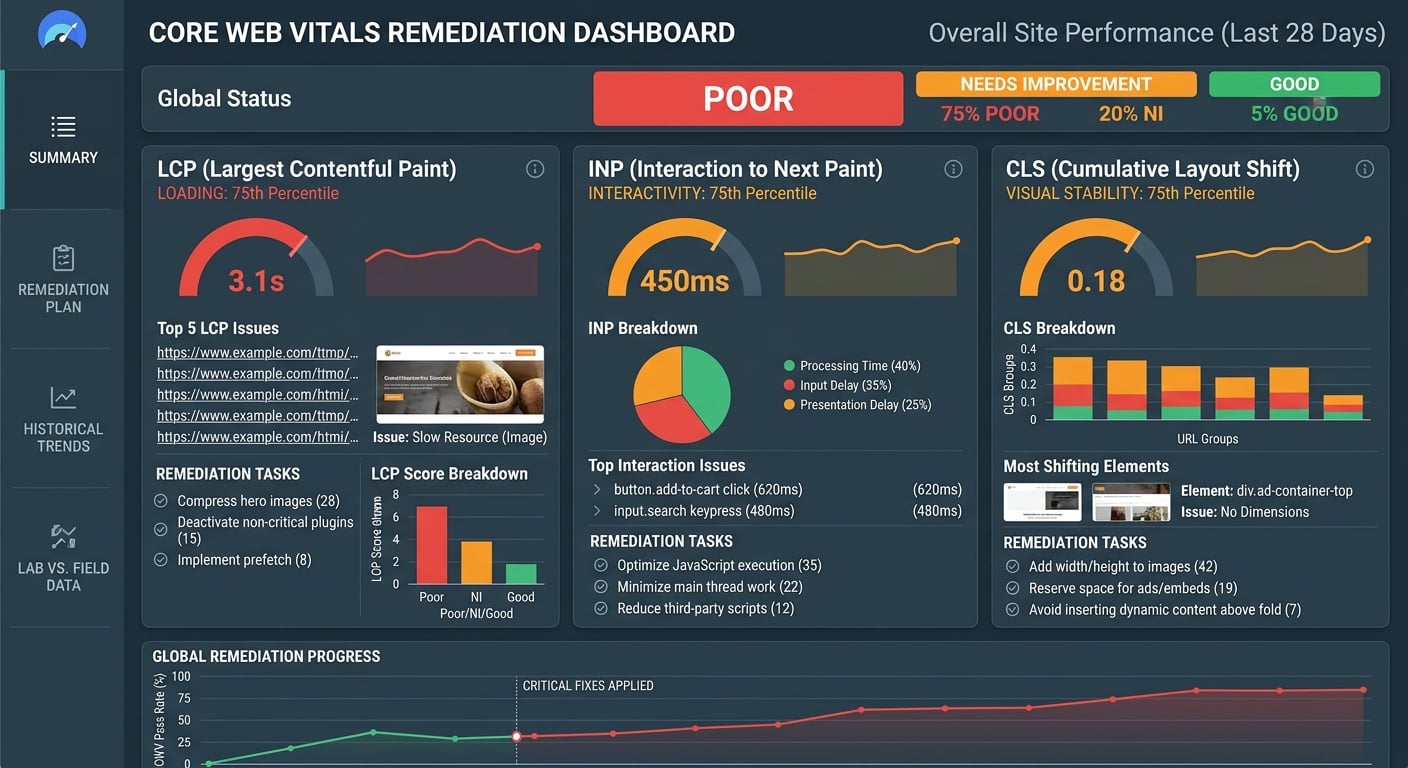
Slow interactions lose buyers. Fix Interaction to Next Paint first.
Interaction to Next Paint (INP) tracks how quickly a page responds after a click, tap, keystroke, menu open, variant choice, or form submit. A good INP is 200 milliseconds or less at the 75th percentile. A page may load quickly but still feel broken when a buyer tries to act. That moment carries real weight. Core Web Vitals remediation for INP starts with the longest real interactions, not guesses.
Large sites often overload the browser’s main thread. Marketing tags, chat tools, analytics, search, personalization, and framework hydration compete for the same resource. During a long JavaScript task, the browser cannot paint a visible response. Users feel that pause. It lowers trust, hurts conversion, and wastes high-intent paid traffic. RankJockey uses field data, traces, and interaction profiles to find scripts that create real business friction.
Break long tasks before users feel the delay
Review each task that runs longer than 50 milliseconds. You do not need to remove all JavaScript. Instead, separate vital interaction code from work that can wait. Delay analytics enrichment and recommendation widgets. Move heavy calculations into Web Workers. Yield the main thread between costly steps. Our Core Web Vitals performance service turns trace findings into clear, release-ready developer tickets.
async function updateCart(items) {
  renderCartSkeleton();
  await scheduler.yield();
  calculatePromotions(items);
  await scheduler.yield();
  renderCartTotals(items);
}- Audit third-party tags: Remove duplicate pixels. Delay low-value vendor scripts until consent or a user action.
- Improve event handlers: Debounce search, scroll, resize, and filter events that keep blocking the main thread.
- Cut DOM work: Virtualize long lists, avoid layout thrashing, and batch visual updates into one render cycle.
- Profile key journeys: Test search, filters, account tools, quote builders, carts, and checkout steps on real mobile devices.
Here is why this matters. Quote tools, checkouts, account areas, and product builders depend on fast feedback. Add Core Web Vitals checks to sprint acceptance criteria. That protects the journey when users show intent. Review our wider advanced SEO packages when INP overlaps with JavaScript design, crawl issues, or weak user journeys.
Your primary offer must appear fast. Optimize Largest Contentful Paint.
Largest Contentful Paint (LCP) tracks when the largest visible page element finishes rendering. On commercial pages, that is often a hero image, product photo, banner, or headline. A good LCP is 2.5 seconds or faster. Server response, asset discovery, image size, blocking CSS, and rendering choices all affect it. Core Web Vitals remediation for LCP maps the full path from request to meaningful content.
Many redesigns create a costly problem. Large video, heavy campaign art, custom fonts, and tag-heavy landing pages can erase gains from better creative. Fast pages do not need bland design. They need sharp priorities. Your first viewport should take the shortest route from request to value. That matters most on mobile networks that are weak or inconsistent.
Prioritize the actual LCP element
Never lazy-load the image users need first. Add width and height values. Use responsive image sources. Serve AVIF or WebP when practical. Preload only the true above-the-fold asset. At the server layer, aim for sub-140ms TTFB with edge caching, lean origin logic, and sensible cache-control rules. The performance SEO team reviews frontend delivery and backend limits together.
<link rel="preload" as="image"
  href="/hero-product.avif"
  fetchpriority="high"
  imagesizes="100vw">

<img src="/hero-product.avif"
  width="1600" height="900"
  fetchpriority="high"
  alt="Enterprise ecommerce product display">
Remove dependencies that do not help visitors understand the page. Inline only vital CSS. Delay noncritical styles. Remove unused framework code. Keep font files small. A technical SEO foundation review shows whether slow LCP starts in the CMS, CDN, server, release process, or creative workflow. RankJockey then builds a clear roadmap around revenue pages first.
Failing mobile Core Web Vitals is costing more than rankings.
RankJockey turns field-data failures into ranked engineering work. That work protects conversion rate, organic visibility, and campaign efficiency. Get a clear remediation sequence for your platform, release process, and commercial targets.
Fix Core Web Vitals NowMoving page elements destroy trust. Eliminate Cumulative Layout Shift.
Cumulative Layout Shift (CLS) measures unexpected movement in visible content. It explains why a shopper taps “Add to Cart” and hits a banner instead. A good CLS score is 0.1 or lower. The score may seem small beside LCP or INP. Yet a shifting page creates instant doubt. It can break forms, cause wrong clicks, and make a serious brand feel careless.
Core Web Vitals remediation for CLS starts by reserving space for every visual item that loads late. Images, embeds, ads, cookie tools, personalized blocks, reviews, chat modules, and promo bars need set dimensions. The browser should know where each item belongs before it arrives. Test logged-in views, local banners, consent states, and experiment versions too. Basic lab tests often miss these real-world conditions.
Stabilize media, fonts, and dynamic modules
Use clear width and height values or CSS aspect-ratio rules for responsive media. Hold space for ad units, even when no ad appears. Preload key fonts only when they earn that priority. Choose fallback fonts with similar sizing. Never insert fresh content above an active call to action. RankJockey often finds CLS problems in small marketing changes, including countdown bars, review badges, affiliate tools, and shipping notices.
.product-media {
  width: 100%;
  aspect-ratio: 4 / 5;
  background: #f5f5f5;
}

.promo-slot {
  min-height: 72px;
}
Use session replay and Chrome tools to find elements that move most. Then add visual checks to design QA and release QA. The right on-page SEO process keeps templates, content blocks, and conversion modules aligned before launch. The bottom line is clear. Core Web Vitals remediation lasts when content teams move fast without breaking the experience buyers and search engines reward.
A green lab score is not enough. CrUX shows what Google sees.
Lighthouse, PageSpeed Insights, WebPageTest, and browser profiles are useful. They do not replace field data. Google’s Chrome User Experience Report (CrUX) collects anonymous data from real users over a rolling 28-day period. Your fixes must work across the devices, networks, regions, and page types your audience uses. A strong synthetic test cannot erase poor mobile experiences in the field.
Field data finds issues that lab tools can miss. A customer may use a midrange Android phone on weak 4G. They may accept cookies, trigger an A/B test, search the site, and view several products. Each action changes the load and interaction profile. Enterprise teams need reports by template, device, country, and channel. Those reports show whether work improves pages that bring qualified demand.
RankJockey uses both sources. Lab evidence finds the cause. Field evidence proves the outcome. Our SEO audit package sets a baseline before developers change the stack. Log file analysis can also reveal crawl waste and server issues that affect speed. Track Core Web Vitals as an ongoing business KPI, not a one-time green badge.
Framework defaults can slow growth. Set rules for React and Next.js.
Modern frameworks can deliver excellent experiences. Their defaults rarely fit a large commercial site. React hydration, large client bundles, client-side data calls, repeated state updates, and broad component libraries can hurt INP and LCP. Core Web Vitals remediation for JavaScript apps needs a firm boundary. Decide what must run in the browser and what can render on the server or edge.
Next.js teams should review client components, route-level code splitting, image handling, cache behavior, scripts, and server component boundaries. Do not ship a full app shell to someone reading one product page. Server-render indexable, high-value content. Load interactive features only where users need them. This lowers JavaScript cost while keeping rich tools where they improve conversion.
Build performance budgets into the release process
Performance budgets create accountability before CrUX shows a decline. Set limits for JavaScript size, third-party requests, TTFB, and page-level LCP. Flag or fail releases that break those limits. This does not slow delivery. It prevents costly cleanup after a launch hurts rankings, paid conversion, and retention.
- Move costly formatting, filtering, and calculations into Web Workers when the task fits.
- Use dynamic imports for chat, maps, review widgets, and below-the-fold sales features.
- Avoid global client state when server data or local component state can do the job.
- Measure pages after consent tools, tests, and tag manager rules have run.
- Review bundle changes in pull requests before new code reaches key revenue templates.
RankJockey gives engineering leaders scalable infrastructure guidance that links release design with search visibility. This work matters after a replatform, redesign, global expansion, or headless CMS launch. For larger planning needs, our SEO strategy research connects technical spend to market demand and page-level opportunity.
Every storefront app adds weight. Protect Shopify and WooCommerce revenue pages.
Ecommerce sites face constant performance risk. Every growth tool wants space on the storefront. Reviews, upsells, subscriptions, loyalty tools, search, personalization, analytics, chat, shipping calculators, and payment widgets all add code. Core Web Vitals remediation must protect product, collection, cart, and checkout paths. On these pages, milliseconds can affect revenue directly.
Shopify stores often keep app code after teams remove the app. WooCommerce sites can collect plugin weight, database calls, theme scripts, and page-builder assets. A generic speed plugin will not solve that problem. Teams need a page-by-page list of scripts, requests, components, and key assets. Remove what adds no value. Delay what can wait. Optimize what buyers use most.
Prioritize the revenue pages before the blog
Start with organic landing pages, category pages, product pages, carts, and paid campaign destinations. Set proper image sizes in product galleries. Simplify variant selectors. Delay low-value recommendation tools. Keep review content from moving purchase controls. Pair speed work with ecommerce SEO strategy so gains reach pages that make sales, not just vanity reports.
Our Shopify SEO specialists and WordPress SEO service teams know each platform’s limits. They do not treat those limits as excuses. Core Web Vitals remediation should keep vital apps while requiring proof that every vendor earns its page weight. RankJockey also adds advanced schema markup cleanly, so structured data supports visibility without adding rendering drag.
Generic fixes leave money behind. RankJockey connects speed to commercial results.
Internal teams can spot obvious speed issues. The harder task is choosing the right priority, tracing causes across systems, and releasing changes without hurting revenue. An experienced technical SEO partner links browser behavior to crawl health, organic demand, conversion paths, and business results. That link turns scattered fixes into one focused plan. It also stops performance work from becoming another unfinished backlog.
Here is what changes when performance work has commercial ownership. Teams stop chasing isolated scores. They focus on the templates and journeys that drive revenue. They test changes before launch and validate them with real-user data after release. That creates safer decisions and clearer return on engineering time.
| Feature | Without Expert SEO | With RankJockey |
|---|---|---|
| Performance diagnosis | Generic Lighthouse suggestions and isolated scores | CrUX, trace, template, and commercial-page analysis |
| INP improvement | JavaScript changes without interaction evidence | Long-task profiling and prioritized main-thread remediation |
| LCP optimization | Image compression only | Critical render path, CDN, cache, asset, and TTFB improvements |
| CLS prevention | Fixes applied after a visible complaint | Component-level dimensions and release QA safeguards |
| Third-party governance | Tags accumulate with no ownership model | Vendor inventory, value review, sequencing, and loading controls |
| Deployment risk | Unplanned changes that can affect revenue pages | Zero downtime rollout sequencing and validation checkpoints |
| SEO impact | Performance tracked separately from rankings | Organic market share, crawl, conversion, and performance reporting |
Core Web Vitals work succeeds when marketing, product, engineering, and SEO share one ranked backlog. RankJockey supports internal developers and outside build partners with clear requirements, QA rules, and validation. Explore our elite enterprise SEO services, review competitor analysis, or book a consultation. We will identify pages where speed can produce the quickest return.
Need a clear path to better Core Web Vitals? Start with these answers.
Build a faster, more defensible organic acquisition engine.
Speed is the starting point. The right SEO program turns stronger pages into lasting search visibility, better content performance, and greater authority.
Your competitors are already buying faster customer experiences.
Do not let slow interactions, weak rendering, and unstable templates drain paid media value and organic revenue. RankJockey builds enterprise-grade remediation plans. Each plan provides a clear route to faster pages, stronger rankings, and measurable conversion gains.