

- The "Near Me" Revolution Nobody Prepared For
- Why the Standard Approach Completely Falls Apart at Scale
- The Duplicate Content Trap Across Location Pages
- The Citation Chaos Problem
- How Rank Jockey Engineers Local Dominance at Scale
- Building a Proprietary Location Page Architecture
- Aggressive Google Business Profile Management
- The Review Strategy That Actually Works
- Citation Cleanup and Data Syndication
- The Franchise SEO Governance Question
- Measuring What Actually Matters in Local Search
- There is Only One Version of Page One
There is an old saying in business: "All politics is local." The same is true for search.
No matter how polished your national marketing campaign is, no matter how impressive your brand's Instagram presence looks, when a person pulls out their phone and types "roof repair near me" or "best Italian restaurant open now," Google is thinking locally. It is not looking at your corporate website's domain authority or your national brand recognition. It is looking at proximity, relevance, and trust signals that are deeply, specifically local.
For a single-location business, this is manageable. You optimize one Google Business Profile, you collect reviews in one city, and you build local citations in one market. It is work, but it is contained.
Now imagine you are a franchise. You have 75 locations scattered across 12 states. You have a corporate website, but you also have 75 individual franchisees who may or may not be actively managing their own online presence. Some of them have their Google Business Profile verified. Others don't even know what that is. One of your Chicago locations has 200 five-star reviews. Another one, just two miles away, has six reviews total - three of which are one-star complaints left unanswered.
This is the local and franchise SEO challenge. It is not just about ranking one page in one city; it is about maintaining consistent, dominant search visibility across dozens or hundreds of markets simultaneously, while ensuring every single location projects the same quality, trustworthiness, and professionalism as your brand promises.
It is enormously complex, and it is the exact problem that the Local and Franchise SEO Services team at Rank Jockey was built to solve.
The "Near Me" Revolution Nobody Prepared For
Here is a number that should stop you cold: searches containing the phrase "near me" have grown by over 500% in the last decade. And that is just the searches where people explicitly type it. The far bigger story is that Google now applies local intent to almost any search that could plausibly have a local answer, even when the user never types a city name or "near me."
If you search for "emergency plumber" from your phone, Google already knows where you are. It will show you plumbers within a few miles, ranked by their local authority signals, not their national domain authority. Your globally recognized plumbing brand with a stunning website means nothing if your individual location pages are not set up properly.
The practical consequence of this is significant. Businesses that dominate local search consistently report that their "near me" organic traffic converts at dramatically higher rates than any other channel. Think about why: a person searching for a service "near me" is not browsing. They are not doing research. They have an immediate need, and they are about to spend money. Getting in front of that person, in that moment, is worth its weight in gold.
Now multiply that by 75 locations and you begin to understand what is truly at stake for a franchise brand.
Why the Standard Approach Completely Falls Apart at Scale
Most SEO agencies understand local search for a single business. Claim the Google Business Profile, get some reviews, build some local citations. That playbook works for a neighborhood dentist.
But when a franchise brand or multi-location business tries to apply that same simple playbook across dozens of locations, it immediately collapses under its own complexity. Here is where it typically goes wrong:
The Duplicate Content Trap Across Location Pages
The most common mistake we see at the enterprise local level is this: a brand creates a "Location Pages" template, fills it with their standard service description, and then just swaps out the city name and address for each location.
The result is 75 pages that are, from Google's perspective, essentially identical. "We provide exceptional [service] in [City Name]. Contact us today."
Google calls this "doorway page" behavior - thin, low-value pages that exist purely for the sake of geographic targeting rather than serving genuine user needs. In the best case, Google ignores them. In the worst case, it actively suppresses them.
A genuinely useful location page for your Denver franchise should answer questions that are specific to Denver. What neighborhoods do you serve? Are there any local regulations or conditions specific to the Denver market that affect your service? Who is the local team? What are past Denver customers saying? Are there local events or community partnerships worth mentioning?
This level of localized depth is what separates the brands that dominate every market they enter from the ones that spend a fortune on a national SEO campaign and wonder why their franchisees are still struggling to get calls.
The Citation Chaos Problem
A "citation" is any online mention of your business's Name, Address, and Phone number - commonly abbreviated as NAP. Google cross-references your NAP data across hundreds of sources (Yelp, Apple Maps, Bing Places, niche industry directories, local chambers of commerce websites) to verify that your business is legitimate and located where it claims to be.
For a single location, keeping your NAP consistent is straightforward. For a franchise with 75 locations, it becomes a data management nightmare of the highest order.
Locations move. Phone numbers change. Franchisees use their personal mobile numbers instead of the business line. Somebody spelled "Avenue" as "Ave" in one directory. Another listing has an old address from before the last renovation.
Every single discrepancy - no matter how minor it seems - chips away at Google's confidence in your location data, directly suppressing your rankings in the local map pack. We have seen major franchise brands lose thousands of monthly local calls simply because 30% of their location listings had incorrect or outdated NAP information scattered across the web.
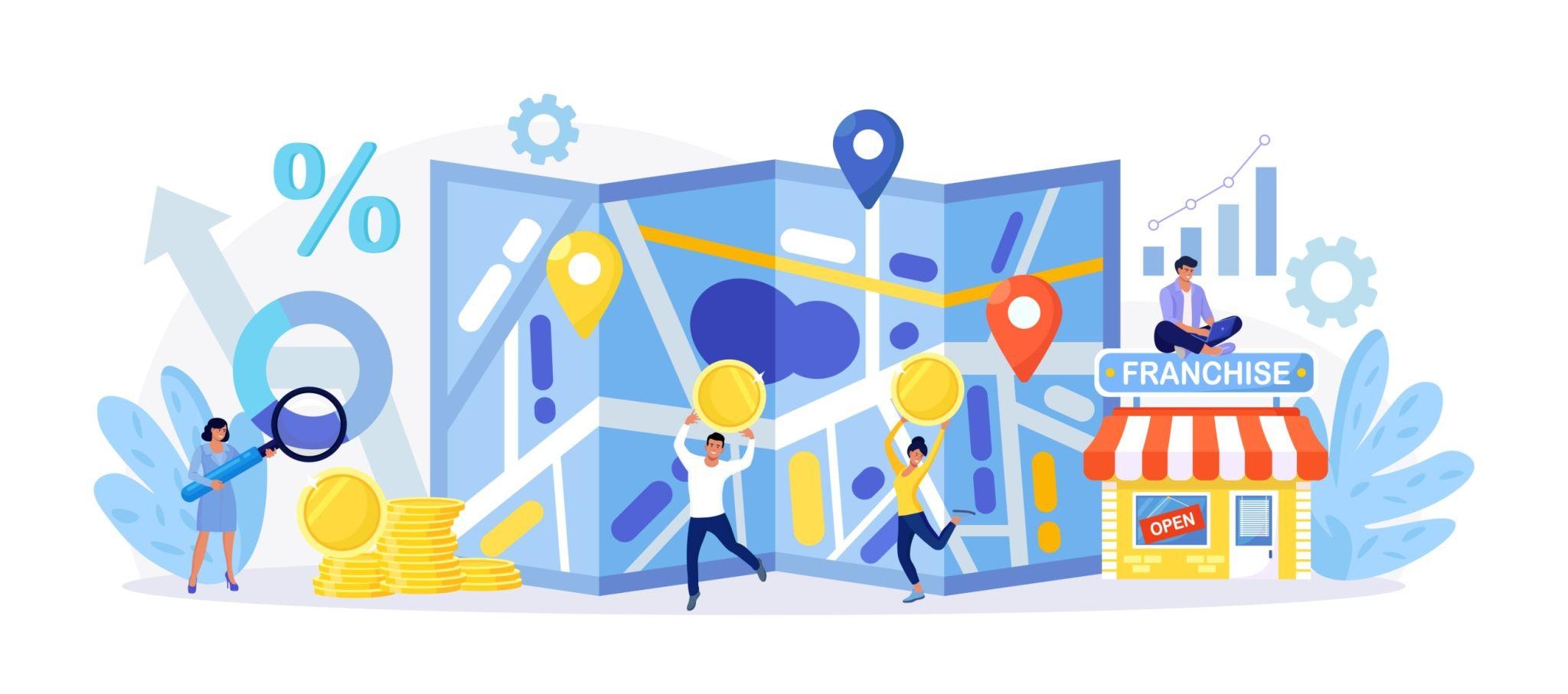
Local and Franchise SEO Strategy for Multi-Location Businesses
How Rank Jockey Engineers Local Dominance at Scale
The approach our team takes to Local and Franchise SEO Services is fundamentally different from what a generic agency can offer. We treat each of your locations like an individual business that deserves its own dedicated local strategy, while simultaneously maintaining the consistency and authority of your overarching brand. Here is how that works in practice:
Building a Proprietary Location Page Architecture
We start by designing a location page framework that is both structured enough to be efficient at scale, and flexible enough to allow for genuine local differentiation.
Every location page in our framework shares the same technical DNA: a consistent internal linking structure, the same Schema markup template, the same page speed targets, the same review integration. This consistency signals brand authority to Google at a domain level.
But every location page also has unique editorial content. We work with franchisees - or we handle it directly through our content teams - to ensure each page reflects the specific community, team, and character of that individual location. This uniqueness is what tells Google that these are genuine, distinct businesses, not a copy-paste content farm.
Aggressive Google Business Profile Management
For most local searches, your Google Business Profile (GBP) is the single most important piece of real estate you own. The "Local Pack" - that map box with three listings that appears at the top of local search results - drives an enormous percentage of local clicks, often more than the organic results sitting below it.
We manage GBP optimization for every single one of your locations with obsessive attention to detail.
We write keyword-rich business descriptions that go far beyond the corporate boilerplate. We categorize each listing with the primary and secondary category selections that Google's algorithm actually rewards. We set up GBP post publishing schedules to keep each profile active and engaging. We geotag every photo uploaded to the listing. We ensure that your question-and-answer section is seeded with the most common queries your customers actually ask.
And crucially - we monitor every profile on an ongoing basis. GBP listings are notoriously susceptible to "listing hijacking," where a competitor or even a random third party suggests an edit to your listing (changing your phone number, for example) and Google auto-approves it. This is more common than most brands realize, and catching it quickly is the difference between a flood of customer calls and complete radio silence.
The Review Strategy That Actually Works
Reviews are not a "nice to have" in local SEO. They are a primary ranking signal - the quantity, recency, and sentiment of your reviews directly influence where you appear in the local map pack.
But generating reviews is psychologically uncomfortable for most businesses. They don't want to seem pushy, so they don't ask at all. Then they wonder why their competitors with objectively inferior service have 200 reviews while they are sitting at 14.
At Rank Jockey, we design systematic, automated review generation workflows for each of your locations. The most effective approach is always speed: reaching out to a customer within hours of completing a service, while their experience is still fresh and positive, dramatically increases the response rate. We set up these follow-up sequences, test the messaging, and measure the conversion rate of each touch-point so we can continuously optimize the system.
Beyond generating new reviews, we also address the negative ones. A negative review left unanswered is a signal to every future customer that your business does not care. A thoughtful, empathetic public response transforms a negative review into a demonstration of character. We train and support your local teams on how to respond appropriately, and for enterprise clients, we can handle this function entirely.
Citation Cleanup and Data Syndication
To solve the NAP consistency problem across every one of your locations, we conduct a comprehensive citation audit at the outset of every engagement. We use specialized tools to surface every mention of your business across the entire web, identify every inconsistency, and systematically correct the data at the source.
We then build new, high-quality local citations across the most authoritative directories and location-specific platforms. And we syndicate your complete, accurate NAP data to the major data aggregators - the upstream sources that feed location data into hundreds of smaller directories, apps, and mapping platforms. Fixing the data at the aggregator level creates a cascading corrective effect across the entire web.
The Franchise SEO Governance Question
Here is a challenge that is unique to franchise brands: who actually owns the local SEO strategy? Is it the corporate marketing team? The individual franchisee? Some combination of both?
This question, if unanswered, leads to chaos. A well-meaning franchisee might decide to "help" by creating a second Google Business Profile for their location, not realizing this creates a duplicate listing that confuses both Google and potential customers. Another franchisee might start leaving SEO completely untouched, letting their local reviews stagnate and their business listing information go out of date.
When we work with franchise brands, one of the first things we establish is a clear governance framework. We define exactly which elements of the local SEO strategy are owned and controlled centrally (by us and the corporate team), and which elements the franchisee has input into. We provide franchisee training, we create simple reporting dashboards that give individual location owners visibility into how their specific location is performing in local search, and we establish escalation processes when something goes wrong.
This governance layer is not glamorous, but it is absolutely what separates brands that scale their local SEO successfully from those that invest heavily and see inconsistent, unpredictable results.
Measuring What Actually Matters in Local Search
One of the most common complaints we hear from brands that have tried local SEO before is that they received reports full of rankings data and impressions numbers, but they could never connect those numbers to actual phone calls, walk-ins, or sales.
We agree. Those vanity metrics are mostly useless.
When we report on a local campaign, we are focused on the metrics that business owners actually care about.
- Google Business Profile calls: How many people clicked "Call" directly from your local listing?
- Direction requests: How many people asked Google Maps for directions to your location?
- Website visits from the local pack: How many people clicked through from your GBP to your location page?
- Conversion events on location pages: How many of those visitors filled out a form, booked an appointment, or initiated a live chat?
We integrate this data with your CRM where possible, so that we can track the complete journey from an organic local search all the way through to a closed sale. When your CFO asks what the SEO investment generated last quarter, you will have a precise, defensible answer - not a vague reference to "improved visibility."
There is Only One Version of Page One
Whether you are a seven-location regional chain or a 500-location national franchise, the math is exactly the same: there is one Page One on Google. There are, at most, three spots in the local map pack. Your potential customers see three options, and they click one of them.
The brands that occupy those spots are not there by accident. They have done the structural work. They have built the location page architecture. They have maintained clean citation data. They have systematically collected thousands of recent, authentic reviews. They have optimized their Google Business Profiles with the kind of obsessive attention to detail that most agencies simply cannot replicate at scale.
Your competitors are doing this right now. And every month they spend at the top of the local map pack while your brand is absent is another month of exclusive leads flowing directly into their business, not yours.
The time to fix this is not next quarter. It is today.
If you are serious about local and franchise growth, book a strategy call with Rank Jockey. We will audit every one of your location listings, show you exactly where you are losing ground to local competitors, and lay out a precise, scalable roadmap to make your brand the dominant force in every market you operate in.
The local search map has room for three. Make sure one of those spots belongs to you.

More on SEO Services Blogs
📌 Elite SEO Technical Resources
Explore our technical optimization pipelines to accelerate crawling, rendering, and conversion performance: